
October 2026 | by Sonal Jessel, Senior Program Director & Yong Jung Cho, Executive Director
There’s a campaign building in Pennsylvania to create a statewide fund that supports public housing authorities in updating thousands of homes badly in need of repairs—and also help the fight against climate change. This campaign started with a group of seniors living in the Blawnox Apartments, a 90-unit senior housing building in Allegheny County, where tenants inhale fumes from the adjacent train tracks that carry coal across the state. The campaign was asking for HVAC upgrades and was exploring rooftop and carport solar. The apartment also lost power in May 2025 after an extreme storm flooded several units and forced the firing up of a rickety generator, pumping diesel fumes throughout the seniors’ homes.
After the storm, tenants scaled up their organizing and demanded more improvements with more urgency.
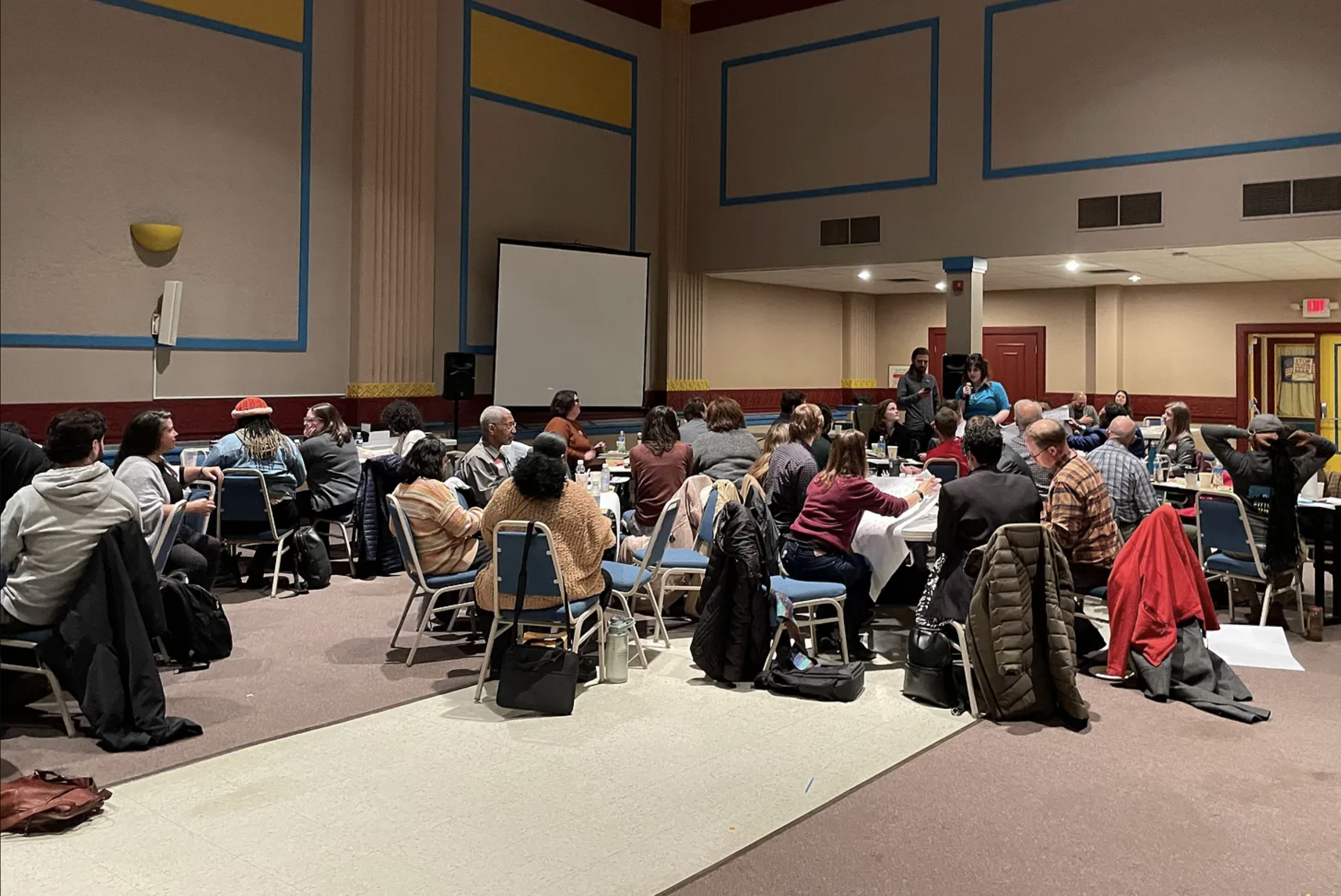
In April 2024, 70 community, labor, and government leaders laid the foundation for what would become the Allegheny Decarbonization Coalition.
BPRC supported the seniors alongside a broad coalition, the Allegheny Decarbonization Coalition, led by Pittsburgh United, since early 2024. We believed Blawnox Apartments could be a “proof-of-concept project,” showcasing to public housing authorities that solutions for climate action and housing affordability can go hand-in-hand, and that these efforts are most successful when led by tenants. BPRC first supported the coalition to apply for a large Inflation Reduction Act (IRA) grant. Then, after President Trump’s cuts to communities by slashing IRA programs, we helped them pivot to other funding sources. The Allegheny County Housing Authority ultimately received $1 million from the Allegheny County budget for energy upgrades.
Allegheny County’s decision to fund this project was a big deal. It was the first time the county had ever given its housing authority money for a decarbonization project. With the investment from the Allegheny County and Housing Authority’s budget, the retrofit is underway and the upgrades will save tens of thousands of dollars in lighting and electricity costs.
Executive Director of Pittsburgh United, Alex Wallach Hanson, and The Heinz Endowments’ Director of Civic Participation, Matt Barron, describe the lessons learned from the Blawnox Apartment campaign in Nonprofit Quarterly earlier this month.
As Alex and Matt write, “the real story is about power and long-term relationships.” They point out that because Pittsburgh United 1) built a diverse coalition that represented powerful constituencies, 2) trained tenants to be real leaders, and 3) had a trusted working-relationship with County Executive Sara Innamorato and her team, they led the coalition to quickly pivot from the failure of a federal strategy to secure a local win. They also explain the details of how they built this power; from the makeup of their coalition, to how tenants had formal leadership roles, to defining “co-governance”. Make sure to check out the full Nonprofit Quarterly piece to understand the campaign and the conditions that made success possible.
Also, stay tuned for more updates from Pennsylvania!
Blawnox Apartments is just the beginning. Public housing is home to an estimated 360,000 people in Pennsylvania, all of whom deserve to live in healthy, well-maintained housing. To improve the public housing stock at this scale, there must be state-level action. That is why we are now focused on winning the Pennsylvania Energy Savings and Jobs Buildings (PAEJ) Fund—a fund that would support housing authorities and other public entities with some funding and dedicated technical assistance in implementation work for the long haul. We’re looking forward to taking the lessons learned from the last nearly three years to win this fund for more communities across the state to have comfortable homes, save on energy bills, and get good jobs.
//
Read this article on our Substack: https://substack.com/@buildingresource. Please subscribe and share!